What happens when a viral hit like “Ok, Boomer” propels a musician to fame?
Peter Kuli’s Insights on Navigating Success and Creativity in the Age of TikTok
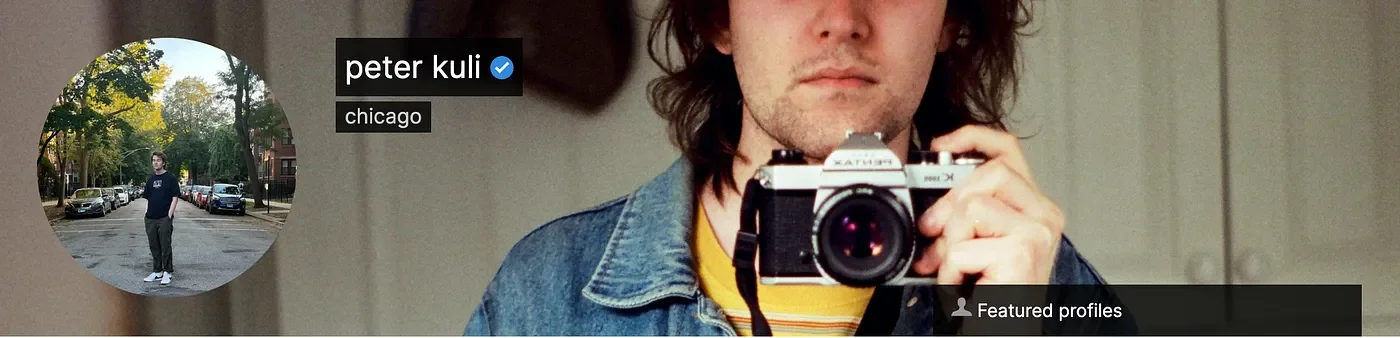
During an age where virality often decrees success, Peter Kuli, the 23-year-old musician behind the viral song “Ok, Boomer,” finds himself at odds with the internet culture which catapulted him to fame. When Kuli first began producing music, it was purely for himself. Digital music production was a complete departure from the structure and hierarchy of recording the classical music he was familiar with. (Instruments of choice include the piano and alto saxophone). Citing influences such as J Dilla and Madlib, Kuli took up sampling 70s soul records and experimenting with lo-fi sounds.
“Now from a production standpoint, I am writing a lot of things from scratch, but I think that process still exists. If I have a synthesizer open…it’s not so much about me playing keys, but about treating those sound sources the same way I would’ve treated a vinyl. Sure, this is a chord progression, and this is a melody, but I can use those same principles and essentially sample myself, pushing these melodic components further beyond what I’m able to write in software.”
Peter’s success has steadily grown over the past decade, collaborating with artists including Still Haze, My Favorite Color, Forrest., and Willy P. One day in July 2019, Jonathan, known through the internet as Jed Will, uploaded the original “Ok, Boomer” song on Twitter. That version was significantly faster than Kuli’s, and included a litany of samples from an N64 game. “Then there was this trend right up to the pandemic and during, where artists would post stems of their songs.” Stems are multi-track exports with files for each section of a particular song, one file for drums, one for bass, etc., and they allow musicians to easily pull and play with sonic puzzle pieces.
Around this time, Jed Will shared a stem for “Ok, Boomer,” and Kuli’s whole community dove in. “I was like, shit, I need to get in on this. I was getting really in my head about what I was writing and I just needed an excuse to create freely.” Kuli flipped his entire approach. “I was like, ‘well let me make a ridiculous SoundCloud, really distorted, rage-type beat just for fun, just to see if I could do it’”. And so, “Ok, Boomer” was reborn. A week later the song hit TikTok, and by that weekend a pool of 7,000 videos were waiting in Kuli’s notification drawer. “I was not expecting it to be as big as it was. It was a very surreal experience.” Today, the song has over 13 million streams on Spotify, and 2.2 million streams on SoundCloud.
While perks like DMs from the New York Times and shout outs from Conan O’Brien were great, the experience also exposed the dark underbelly of major music labels. “Around the time that ‘Ok, Boomer’ came out, I signed a first-look deal with a record label, and presented them with 5 songs. They were going to go forward with one, and the very first thing they asked me was which part of the song was the TikTok part.” Now, it’s difficult to unsee the effect content has had on music composition. You can listen through the Top 40 charts and easily identify which section of each song was written for the purpose of TikTok. There’s no doubt that content culture has failed artists. “What’s tricky about trying to capture and create these viral moments is that there’s not really an investment in the trajectory of the artist as a whole, in their audience and fandom, and figuring out how to expand that.”
Since “Ok, Boomer”, Kuli’s production methods continue to mature. “I think now I’m at a place where my creative process separates concept and execution more,” he explains. “I might have an 8-bar idea, and it may not sound great, and I may not really like it, but there might be certain elements that conceptually work, and could be taken and manipulated in another project or in a different context.” Experimentation, iteration, and patience are the cornerstones of Kuli‘s approach (plus soundbites make for great content). The modern pressure for both rapid creation and online success brings us also to a broader contemplation of the digital age’s impact on how we generate art.
While short-form content has a myriad of draw-backs including minuscule pay and squeezing ad dollars out of virality like a sponge, users still flock to social platforms for small truths and ways to affirm their lived reality through their phone’s reflection. The digital age highlights a universal truth about art: it lies suspended between our attempts to recreate reality, and to shed ourselves of tradition in pursuit of perfection and the new. It is both personal expression and social artifact. However, as Camus marvelously wrote, when the artist is “cut off from his society, he will create nothing but formal or abstract works, thrilling as experiences but devoid of the fecundity we associate with true art, which is called upon to unite.”
Now the query which drives us isn’t whether the content-ification of music (and art broadly) is harmful, but rather how, in a world where social media is a given, we can treat content as a tool for community building and supporting independent artists. Kuli’s methodology has been one of shifting from a production-consumption dynamic with his audiences to one of co-creation. “Art is all about perspective. Art is everyone’s entire lived experience filtered through their medium.” He collaborates with musicians around the globe through “URL songwriting,” and shares behind-the-scenes videos with his audience, discovering new middle grounds between himself and other artists. “It seems like…now TikTok is a place to expand an audience, rather than create it.”
Kuli leverages live, smaller, community-driven venues such as Bookclub in Chicago to further foster community. “The space itself can only fit 75, maybe 80 people at most, but when I’m done performing, every single person will come up to me, talk to me, and be really thrilled about what I did.” He elaborates, “Those [community] spaces still exist, there’s just less of them. So it’s just a matter of finding someone who’s invested in making those spaces, or making them yourself.”
Peter Kuli exemplifies how we can thread the proverbial needle of creating art within the modern online landscape. Your art couldn’t come from anyone else but you, and our digital growing pains will not stop our ceaseless optimism.